


Contact information
Professor David Stuart Research Group
Henry Wellcome Building of Genomic Medicine
 |
David Stuart
FRS
Professor of Structural Biology
- Co-Head of STRUBI, NDM, University of Oxford
- Senior Research Fellow in Medicine at Hertford College, Oxford
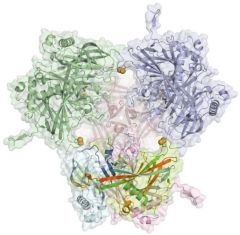
Viruses are attractive targets for study at the molecular level, since they are sufficiently simple that we may hope to achieve a rather complete understanding of their biology. In practice, although their genomes are compact, they display astonishing diversity, both in structure and function. Our attempts to relate structure to function have benefited from the developments in X-ray crystallographic methods that have brought very complex structures within reach of description in atomic detail. Our targets range from picornaviruses, small ssRNA viruses, which include a number of important animal and human pathogens, to the larger dsRNA viruses and giant eukaryotic viruses. At both ends of this spectrum (from less than 10,000,000 to about 1 giga Dalton) we now have representative atomic structures.
Our efforts are particularly focused on virus-receptor interactions and basic puzzles of virus assembly. Our studies here are highly collaborative, with strong links with a number of virologists (B. Charleston and T. Tuthill (Pirbright), D. Rowlands (Leeds), P. Roy (University of South Florida), A. Huang (National Taiwan University) as well as numerous groups elsewhere in Europe).
Work on cell-surface molecules is largely performed in collaboration with the group of Prof. E.Y. Jones, whose entry describes many of the projects.
We have a particular interest in studying virus evolution and many of these studies are performed in collaboration with virologists in Helsinki.
Recent publications
Structural and functional mapping of protective human monoclonal antibodies against enterovirus A71
Journal article
Zhou D. et al, (2026), Science Advances, 12
Biographical Feature: In memory of Dennis Henry Bamford (1948-2025), who changed how we see viruses.
Journal article
Stuart DI. et al, (2026), Journal of virology
Author Correction: Production of an immunogenic trivalent poliovirus virus-like particle vaccine candidate in yeast using controlled fermentation.
Journal article
Sherry L. et al, (2026), NPJ vaccines, 11
Cattle antibodies identify a cross-serotype broadly neutralising foot-and-mouth disease virus epitope.
Journal article
Bonnet-Di Placido M. et al, (2026), NPJ vaccines, 11
The low-density lipoprotein receptor LDLR mediates cellular entry of nonenveloped hepatitis A virus.
Journal article
Shiota T. et al, (2026), Proceedings of the National Academy of Sciences of the United States of America, 123